Menopause Health Report | For women navigating the menopause transition

Sponsored Research Report  •  Menopause & Musculoskeletal Health

A Silent Hormonal Shift Inside Menopause Is Triggering Widespread Joint Pain

And a PubMed-Backed Discovery Is Finally Exposing the Source Instead of Telling Women It’s “Just Aging”

Menopause Warning Sign — woman with shoulder pain, declining estrogen chart

A 2024 landmark review officially introduced Musculoskeletal Syndrome of Menopause (MSM)—revealing why frozen shoulder, stiff joints, and tendon inflammation seem to strike almost overnight.

Women everywhere are describing the same strange pattern.

A shoulder that suddenly refuses to move the way it used to.

Knees that feel stiff on the stairs.

Hips that ache after sitting.

Tendons that stay sore longer than they used to.

And mornings where the whole body feels ten years older than it did the night before.

Four-panel montage: frozen shoulder, knee pain on stairs, hip pain, back pain

The confusing part is that these problems are usually treated as separate events.

The shoulder gets called overuse. The knees get blamed on age. The sore heel gets treated like a random injury.

And the woman living inside that body is left wondering how everything seemed to change at once.


For years, women have been given the same explanations

“You slept on it wrong.”

Repeated to women presenting with sudden, severe shoulder restriction.

“You need to stretch more.”

As if a tissue condition driven by hormones will respond to stretching alone.

“That is what happens as you get older.”

Said to women in their mid-40s presenting with rapid-onset symptoms.

“It is probably inflammation.”

True — but inflammation in this context may have a root cause that is often left unaddressed.

“You may simply be doing too much.”

The default answer when nothing else explains the symptom pattern.

Some of those factors can matter.

But researchers began asking a bigger question

Why do so many joint, muscle, tendon and bone complaints appear during the same hormonal transition?


In 2024, researchers introduced a new term

In 2024, orthopedic surgeon Dr. Vonda J. Wright and her co-authors published a peer-reviewed review in the medical journal Climacteric.

They introduced a new term to help clinicians and women discuss what they were observing:

Named in a 2024 peer-reviewed review

THE MUSCULOSKELETAL SYNDROME OF MENOPAUSE

A newer way to describe the cluster of musculoskeletal changes associated with declining estrogen — connecting problems women were often told to view separately.

70%

of women may experience musculoskeletal symptoms during the menopause transition

25%

may be significantly affected by those symptoms in ways that disrupt daily life

It doesn't stay in one joint

Estrogen receptors exist in joints, cartilage, muscle, and tendon. When levels drop, all four can react — sometimes at the same time.

Shoulder joint anatomy
ZONE 1 — SHOULDER
Frozen shoulder
Stiffness and limited overhead range that appears without injury — linked to collagen loss in the joint capsule.
Knee joint cartilage
ZONE 2 — JOINT
Knees and hips
Cartilage thins faster after estrogen decline. Morning stiffness, deep aches, difficulty with stairs.
Muscle fiber anatomy
ZONE 3 — MUSCLE
Muscle loss
Estrogen supports muscle protein synthesis. After menopause, strength declines faster and recovery takes longer.
Tendon anatomy
ZONE 4 — TENDON
Tendon soreness
Collagen in tendons degrades without estrogen. Heel pain, elbow aching, ankle tightness that won't resolve.
Impact Map

Where estrogen loss shows up in the body

Frozen shoulder
Joint capsule collagen breaks down — stiffness without any injury
Tendon pain
Collagen in tendons degrades — heel, elbow and ankle soreness
Lower back
Lumbar disc collagen degrades — stiffness on waking is often the first sign
Hip stiffness
Cartilage thins faster — deep ache and difficulty with stairs
Knee pain
Articular cartilage loses estrogen support — swelling and morning stiffness

All five may appear during the same hormonal transition — often dismissed as separate, unrelated problems.

Body diagram showing 5 MSM pain zones

This does not mean every sore shoulder or stiff knee is caused by menopause.

It means the timing and the wider pattern deserve to be taken seriously instead of dismissed as a collection of unrelated complaints.


The paper is not a social-media theory

It is a peer-reviewed review indexed on PubMed:

PubMed-Indexed Review Climacteric 2024

“The musculoskeletal syndrome of menopause”

Vonda J. Wright et al.
Climacteric. 2024 Oct;27(5):466–472.

PMID: 39077777

The authors introduced this term to help clinicians and women discuss the collective musculoskeletal signs and symptoms associated with estrogen loss.

Laptop showing PubMed listing for The musculoskeletal syndrome of menopause, Climacteric 2024, PMID 39077777

Dr. Vonda J. Wright

Orthopedic surgeon • Lead author of the 2024 review “The musculoskeletal syndrome of menopause” (Climacteric)

In her practice, Dr. Wright sees women in their mid-40s presenting with sudden-onset frozen shoulder — before any other menopause conversation has happened. The symptom pattern led her research team to name the broader category.


Dr. Wright and the cited researchers are referenced for their published work only. They are not affiliated with this publication and do not endorse any specific product.

From The Clinic

What Dr. Wright sees
in her patients

In explaining the musculoskeletal syndrome of menopause, Dr. Wright describes a pattern many women recognize immediately.

“I’ll see a 46-year-old woman come in with shoulder pain. She says, ‘I didn’t do anything. I don’t know what happened.’”

What women with sudden frozen shoulder often tell Dr. Wright

“When we think of hormone replacement therapy as something that’s only good for hot flashes, night sweats and brain fog, we’re leaving out… the other amazing functions of estrogen.”

Menopause affects more than temperature, sleep and mood

“Those tissues all are responsive to estrogen.”

Including muscles, joints, tendons, ligaments, bones & cartilage

That is the part many women were never told. Estrogen was not only involved in hot flashes or night sweats — it was also supporting the tissues that help the body move comfortably.


Estrogen receptors are found throughout the body — including tissues involved in movement

As estrogen declines, the effects may reach beyond temperature regulation or sleep.

The muscles, bones, joints, tendons, ligaments and other connective tissues can all be part of the conversation.

That helps explain why the symptoms can feel so scattered — even when they began around the same stage of life.

STAGES OF MENOPAUSE ESTROGEN LEVEL Pre-menopause Peri-menopause Menopause &postmenopause 0 35–45 ~51 AGE Joint symptoms cluster here
Illustrative: estrogen falls steeply through perimenopause, then stays low — the window when musculoskeletal symptoms most often appear.
  • Estrogen is a critical anti-inflammatory in the body. As it declines, joint inflammation may increase.
  • Bone depends on estrogen for its density. Women can lose 15–20% of bone density in the five-year window surrounding menopause.
  • Muscle mass declines around menopause — but strength training can rebuild it.
  • Cartilage is built around a collagen-rich matrix that helps the joint stay strong, smooth and resilient. As estrogen declines, the body may have a harder time maintaining that collagen structure.
  • Spinal discs contain estrogen receptors. As estrogen falls, they may dehydrate, contributing to compression and back pain.

Inflammation may be part of the picture. But it may not be the whole picture.

Estrogen decline can also affect the collagen-rich structure that helps cushion the joints. And when collagen maintenance slows, the cushion itself can begin to change.


The cushion inside the joint can become thinner, flatter and less resilient

Collagen is part of the structure that helps cartilage stay strong, smooth and able to absorb pressure.

When collagen maintenance slows, that cushion may have a harder time holding its shape and moisture.

That can help explain why everyday movement starts to feel different:

  • You suddenly can't reach behind your back to fasten your bra
  • Washing or brushing your hair becomes surprisingly painful
  • Reaching into a high cabinet makes you wince
  • Joints feel stiff after sitting or sleeping
  • Stairs become less comfortable
  • Movements that used to feel effortless now feel restricted

It can feel like the body aged overnight. But the change may have been building beneath the surface as the joint cushion gradually lost structure and springiness.

Less collagen means less structure. Less structure means less cushioning with every movement.

And that is why the things women usually try first may help one part of the problem without addressing the collagen-rich cushion itself.


Why the usual solutions can miss the collagen bottleneck

Hormone therapy patch box and tablets on a kitchen counter

HRT

Supports the hormonal environment.

Different job than supplying joint-building materials.

Woman doing a light dumbbell shoulder exercise at home

Exercise & PT

Builds muscles and improves movement.

Different job than rebuilding the joint cushion.

Turmeric capsules, omega-3 softgels and glucosamine tablets in small dishes

Turmeric / Omega-3 / Glucosamine

Helps support comfort and a healthy inflammatory response.

Different job than supplying the collagen-rich structure that cushions the joint.

They are not bad solutions. They simply do different jobs. The missing job is rebuilding the collagen-rich cushion inside the joint.


Picture healthy joint cartilage like a wet sponge

Side-by-side comparison: a full hydrated sponge labeled Soft and Springy versus a dry flat sponge labeled Flat and Stiff
🟢

Hydrated Sponge

Soft, springy, full. Helps absorb pressure and supports smoother movement.

🔴

Dry Sponge

Flat, stiff, less resilient. Pressure isn't absorbed the same way.

That is why simply trying to “calm it down” may not feel like the whole answer.

A crumbling sponge does not only need to be wetted. It needs to be rebuilt and re-soaked.


The joint cushion needs three simple jobs covered

Three ingredient cards: Collagen the Sponge, Vitamin C the Builder, Hyaluronic Acid the Moisture

CARD 1

Collagen

The Sponge

This is the sponge itself.

Without the sponge, there's nothing to cushion your joints in the first place.

CARD 2

Vitamin C

The Builder

Vitamin C helps rebuild the sponge.

Think of it like repairing all the little holes and tears before the sponge can work again.

CARD 3

Hyaluronic Acid

The Moisture

Now the sponge needs to soak up water.

Hyaluronic acid helps fill the sponge with moisture so it becomes soft, springy, and able to cushion every step again.

Remove one job and the sponge inside your joint cannot work properly

  • No sponge? Now there's less collagen structure cushioning your joints.
  • No builder? Now your body can't properly assemble and maintain that collagen structure.
  • No moisture? Now your joint cushion stays flatter, drier and less springy.

Rebuild the collagen structure. Re-soak the cushion with moisture.


That research trail is what makes Revive Mix different from another quick pain fix

Five women in their forties and fifties together in a living room, each holding a pouch of Revive Plus Mix
One Scoop A Day Unflavored 0 g Sugar 60-Day Guarantee
Shop Now

One scoop a day • 60-day money-back guarantee

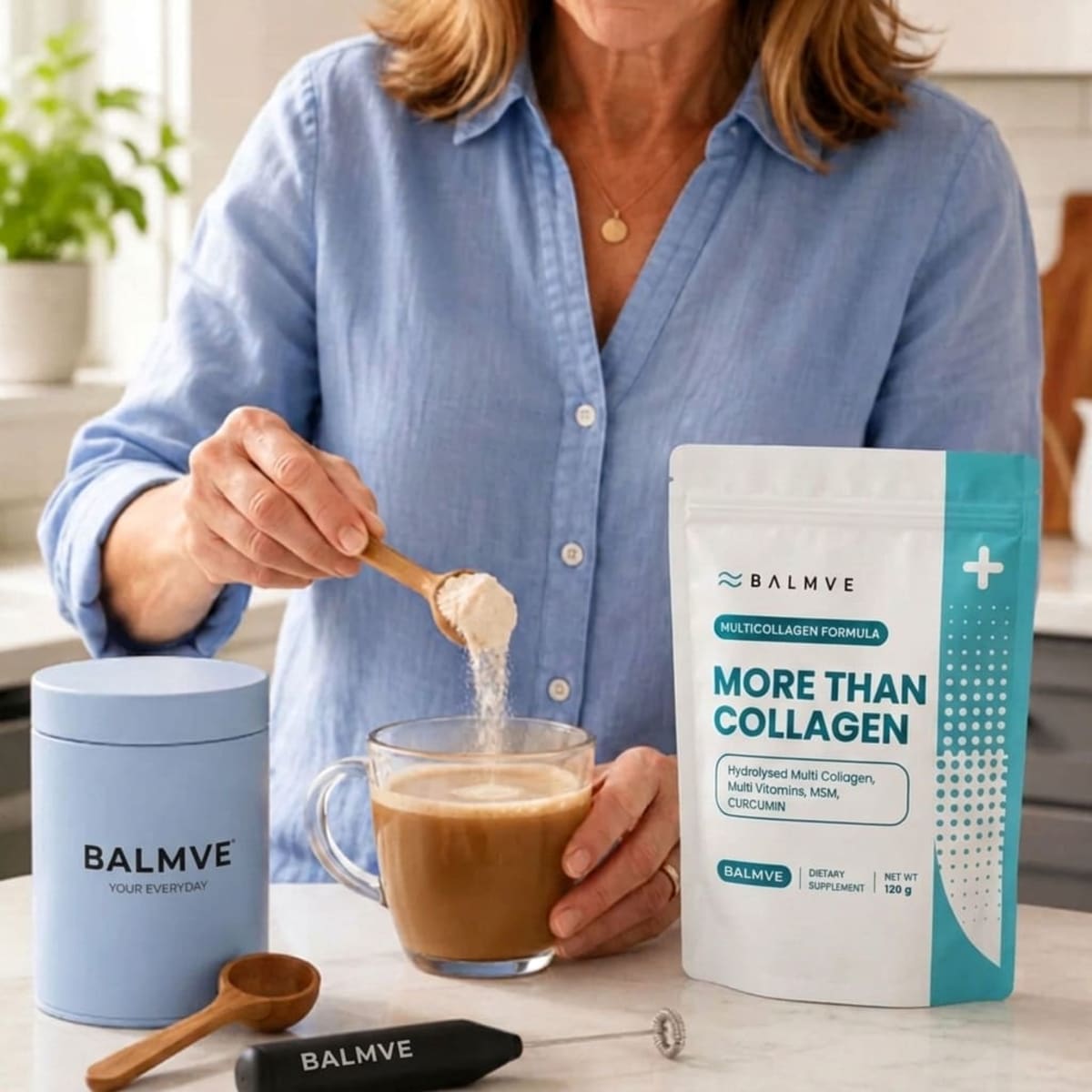
Revive Mix was designed as a daily nutritional joint-support routine. One unflavored scoop combines collagen, undenatured Type II collagen, vitamin C, hyaluronic acid and additional joint-support ingredients in a formula built around comfortable movement.

  • It does not diagnose or treat the musculoskeletal syndrome of menopause.
  • It does not replace medical care, physical therapy, strength training or a conversation about hormone support.
  • Its job is simpler: support the joint-nutrition side of the routine.

The Type II collagen inside the formula has its own clinical evidence

Undenatured Type II collagen has been studied as a standalone ingredient.

UC-II undenatured Type II collagen infographic: 40 mg daily WOMAC results, improved knee extension and range of motion, and why Type I and III collagen target beauty rather than joints

Published trials on the ingredient

#26822714

Randomized controlled trial • 180 days • Knee osteoarthritis

40 mg daily significantly improved overall WOMAC outcomes compared with placebo and glucosamine plus chondroitin

Design: RCT, participants with knee osteoarthritis, 180-day intervention

#24153020

Randomized study • Healthy adults • Activity-related joint discomfort

Improved knee extension reported with 40 mg daily undenatured Type II collagen

Design: Randomized, healthy subjects with activity-related knee discomfort

#35377244

Randomized study • Range of motion

Improved range of motion and flexibility outcomes with 40 mg daily

Design: Randomized controlled study in adults with knee discomfort

Try Balmbare Now

One scoop a day • 60-day money-back guarantee

Medical & Research Disclaimer. This page is educational and does not provide a diagnosis. Frozen shoulder, joint pain, tendon pain and stiffness can have many causes. New, severe, persistent or unexplained symptoms should be evaluated by a qualified healthcare professional.


Dr. Vonda Wright and the cited researchers are referenced for their published work on the musculoskeletal syndrome of menopause. They are not affiliated with this publication and do not endorse any specific product.


Ingredient studies cited were conducted on the individual ingredients or ingredient forms, not on Revive Mix as a finished product.


These statements have not been evaluated by the Food and Drug Administration. This product is not intended to diagnose, treat, cure or prevent any disease.


Sources: Wright VJ et al. “The musculoskeletal syndrome of menopause.” Climacteric. 2024;27(5):466-472. PMID: 39077777 • Lugo JP et al. PMID: 26822714 • Crowley DC et al. PMID: 24153020 • Stanek A et al. PMID: 35377244